PT with JT: Solving Running Injuries Before They Start
Wednesday, September 2, 2026
By: Nicky Tamberrino, Host of the “Maybe Running Will Help” Podcast
On the latest episode of Maybe Running Will Help, host Nicky Tamberrino sat down with Jacob Travis — known to his nearly 70,000 Instagram followers as PT with JT — a Nashville-based physical therapist, run coach, and marathoner chasing a sub-2:50. The conversation ranged from the science of why running makes us open up, to faith and identity, to some of the most practical injury advice you’ll hear from a PT. Here are the highlights.
Running as Therapy — With a Little Science Behind It
The episode kicked off with a nod to one of JT’s viral reels, a joke about how runners are “chosen” — and the deeper truth underneath the humor: running builds community in a way that starts to feel like therapy. JT described how he went from being a heads-down, headphones-in gym regular to finding a run club in Nashville almost on a whim, and how the conversations that came out of those miles became something more meaningful than just training.
Nicky backed that up with science, referencing an upcoming podcast episode on run-walk-talk therapy — including research on why we open up more easily mid-run. Without the pressure of direct eye contact, and with the parts of the brain responsible for anxiety quieting down during movement, a run can feel a lot like truth serum. As Nicky put it: “I’ll finish a run and I’m like, I can’t believe they literally know all my secrets.”
Faith, Identity, and Why We Push Our Bodies
JT opened up about a newer thread in his content: a series exploring what it means to have a body from a spiritual perspective. After years of considering himself Christian without fully living it out, he’s been leaning into the question of how his faith intersects with his work as a physical therapist and his own athletic goals.
That reflection was shaped in part by a shoulder dislocation that sidelined him from running for six months. Looking back, JT sees it as “a weird blessing in disguise” — it made him a better PT, taught him humility, and forced him to examine how much of his identity had been tied to his fitness. The two also talked about the tension between chasing hard goals and not letting those goals become an idol, and agreed that running has a built-in way of keeping runners humble — as JT joked, roughly 80% of runs aren’t going to be your best.
His Running Story: From First Run Club to Chasing Boston
JT’s running journey started about four years ago, prompted by a run club invite. His first outing — trying to keep pace with a group of former college athletes — ended in what he called “the run of shame,” walking the last stretch after hitting a wall he’d never experienced. Rather than being discouraged, it hooked him: he set a goal to run a half marathon six months out, followed a training plan from a friend who happened to be a run coach, and got hooked on the race-day atmosphere.
From there, his marathon times tell the story of steady, deliberate progress — 3:14 in his first Indianapolis Marathon, then 2:59:37 in his second, missing sub-3 by just 23 seconds. This year, he’s back at Indianapolis chasing a sub-2:50 to put himself in range of a Boston qualifying time.
The Most Misdiagnosed Running Injuries
As a PT, JT sees a lot of self-diagnosis go wrong. Plantar fasciitis tops the list — any foot pain, and people assume that’s what it is, when the real cause can range widely, including stress fractures that are more common than most runners realize. Shin splints are the most common injury he treats overall, and another one that requires ruling out more serious issues.
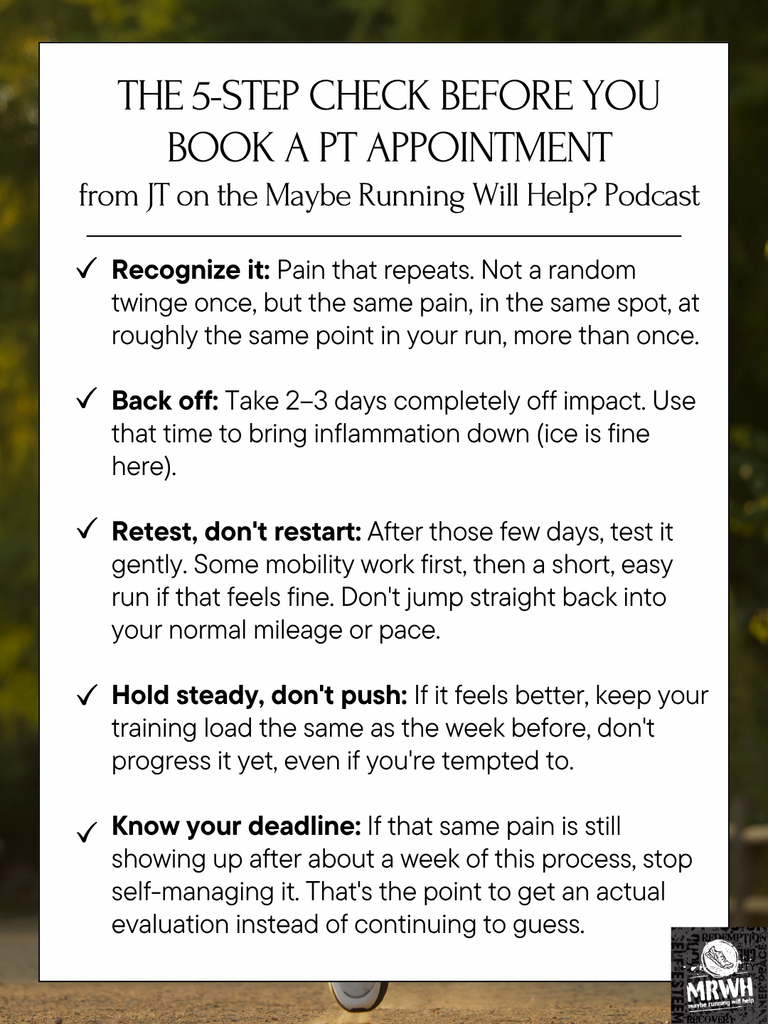
His rule of thumb for when to see someone: if a pain is showing up consistently, in the same spot, at the same point in your run, don’t let it linger. Treating it early tends to shorten the whole recovery timeline. He’s also candid about the limits of tools like ChatGPT for self-diagnosis — useful as a jumping-off point, but no substitute for a hands-on evaluation, given how individual pain and its root causes can be.
Should You Rest, or Get It Checked?
On the age-old question of the RICE method, JT’s answer is nuanced. If it’s a first-time twinge, there’s no need to panic. But if pain lingers, he suggests a roughly one-week test: back off impact for a few days, work in some light mobility and strengthening work for the affected area, and reintroduce running gradually — keeping mileage flat rather than progressing it that week. If the pain doesn’t return, you can build back up. If it keeps coming back, it’s time for an evaluation.
He also stressed that rest alone is rarely the full fix for a running injury. If you rest until the pain fades and then return to the same mechanics and deficits that caused it, the injury tends to come right back.
Why Sleep Might Be the Most Ignored Advice
Asked what advice he gives that people most often ignore, JT didn’t hesitate: sleep. He says he’ll trade a week of physical therapy exercises for a week of good sleep any day — and that clients who finally commit to consistent sleep are often shocked at how much better they feel. It’s a piece of recovery that’s easy to overlook next to the more visible work of stretching and strengthening, but he treats it as foundational, especially during injury recovery.
Do You Need to Fix Your Running Form?
For most runners, JT’s advice is simple: don’t touch it. Running form is highly individual, and unless you’re dealing with recurring pain tied to a specific mechanic, or you’re chasing a performance goal and there’s an easy efficiency gain to be had (like reducing an overly upright trunk), your natural form is exactly how your body is built to run. Changing mechanics only makes sense when there’s a clear reason to.
Mental Tricks for the Hard Miles
Nicky and JT swapped strategies for getting through the tough late miles of a race. JT’s go-to is breaking the course into small visual chunks — focusing only on the next landmark, then picking a new one — and shifting focus to a body part that still feels good, like an easy arm swing, when everything else starts to hurt. He also emphasized the value of preparation itself: taking a moment before the race to mentally review the hard training runs you’ve already survived, and letting that be the source of confidence at the start line.
Runner’s Reset: A Program for the Pieces Strength Training Misses
JT also talked about his Runner’s Reset Program, a four-week neuromotor control program designed to fill a gap that pure strength training doesn’t address — things like foot and ankle control, single-leg balance, and hip alignment. It’s meant as a supplement to strength training and running, not a replacement for physical therapy, and works well either as marathon-block prep or a way to build better body awareness generally. For runners with real, lingering pain, he still recommends a full evaluation over a self-guided program.
Find JT
You can find Jacob Travis on Instagram, TikTok, and now YouTube at PT with JT, where he’s expanding into longer-form content — including a documentary following his 16-week training block for this year’s Indianapolis Marathon. He also offers free connection calls for in-person physical therapy or online coaching through PTwithJT.net.
Catch the full conversation on Maybe Running Will Help with Nicky Tamberrino.